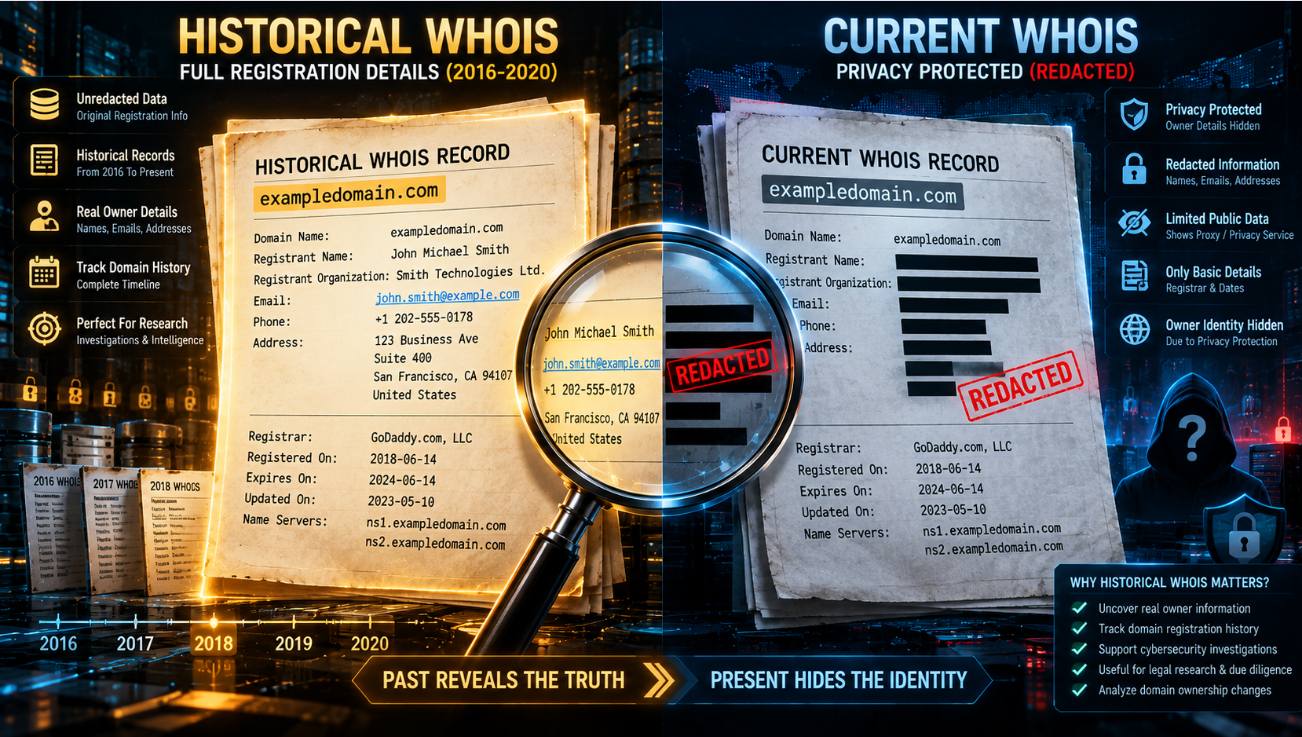
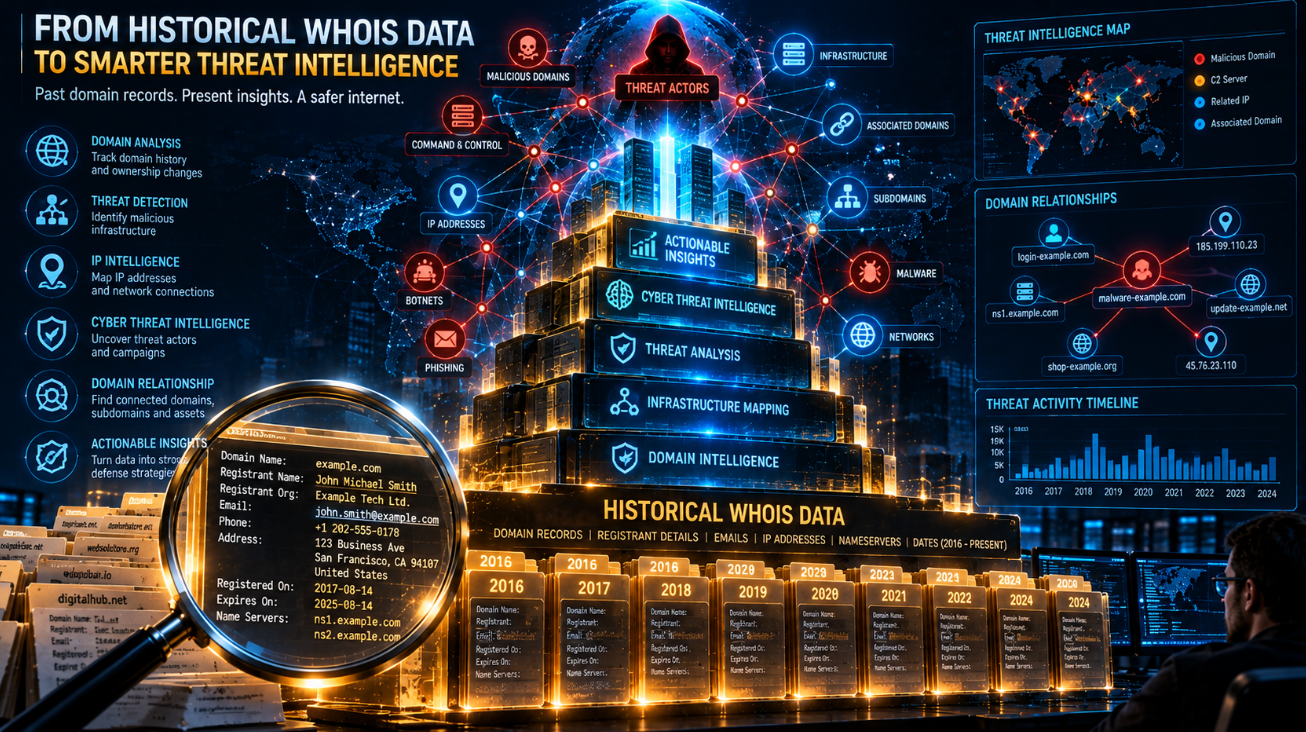
Historical WHOIS data is essential for threat intelligence because it preserves the unredacted ownership details, contact information, and registration patterns that current WHOIS records now hide. Since GDPR redaction took effect in May 2018, live WHOIS lookups reveal almost nothing about who actually operates a malicious domain. Historical archives cut through that wall of privacy protection, exposing the email addresses, names, and infrastructure relationships that make attribution possible. Without historical records, threat intelligence teams are left guessing. With them, they can map entire adversary networks, connect seemingly unrelated attacks, and build evidence that stands up in court.
The Threat Intelligence Visibility Problem
Modern threat intelligence depends on one fundamental capability: seeing connections that aren't obvious. A single phishing domain is an isolated data point. But that same domain, linked to forty others through a shared registrant email, becomes a campaign. Linked to a registrar used exclusively by one actor, it becomes attribution.
Current WHOIS records break this chain. When a threat actor registers a domain through a privacy service, the live record shows only technical data: nameservers, registration dates, and a redacted placeholder. The investigator sees a locked door with no key.
Historical WHOIS data provides that key. Before GDPR, registrants supplied names, email addresses, physical addresses, and phone numbers that were published openly. Commercial archives captured these records continuously, preserving snapshots of every domain's ownership history. Those snapshots remain accessible and legal to use, because they document information that was public when it was collected.
Attribution: Connecting Attacks to Actors
Threat attribution is the process of determining who is responsible for an attack. It is notoriously difficult, and it depends on finding patterns that link separate incidents to a single source. Historical WHOIS data enables attribution in several concrete ways.
Reusing Email Addresses
Threat actors are creatures of habit. Many register dozens or hundreds of domains using the same email address, sometimes across years. When a historical record reveals an unredacted email, say, an address used to register a phishing domain in 2016, investigators can run a reverse WHOIS query to find every other domain ever registered with that address. The result is often a sprawling map of infrastructure that current records conceal entirely.
Registrar and Naming Patterns
Actors also display preferences for particular registrars, top-level domains, and naming conventions. One group might register domains exclusively through a specific reseller. Another might favor hyphenated brand names or misspellings of well-known companies. Historical records preserve these patterns across time, allowing analysts to build behavioral profiles and match new domains to known actors before an attack occurs.
Timeline Correlation
Attribution strengthens when separate attacks share a timeline. Historical WHOIS records include precise registration dates. If two unrelated phishing campaigns both deployed domains registered within the same 48-hour window, through the same registrar, using the same email pattern, the probability that a single actor is responsible increases dramatically.
Infrastructure Mapping: Seeing the Full Picture
Infrastructure mapping is the practice of charting an adversary's complete domain and server footprint. It transforms threat intelligence from reactive blocking into proactive disruption.
Historical WHOIS data serves as the foundation of this mapping process. The workflow typically follows four stages.
Stage one begins with a known indicator of compromise, a malicious domain identified in an attack. The investigator queries its historical WHOIS record and extracts any unredacted details from the pre-GDPR era.
Stage two involves pivoting. Using reverse WHOIS lookups on discovered email addresses or organization names, the analyst finds all other domains connected to the same identifiers. Each new domain is then queried for its own historical records.
Stage three enriches the map with DNS intelligence. Historical DNS resolution data reveals which IP addresses each domain has pointed to, and reverse IP lookups uncover other domains hosted on the same servers. Passive DNS databases capture these relationships even after the infrastructure is taken offline.
Stage four connects everything into a graph. Domains, IP addresses, nameservers, registrant identities, and ASN data become nodes and edges in a network diagram that reveals the adversary's operational structure. This graph guides blocking decisions, informs takedown requests, and supports law enforcement referrals.
Historical WHOIS Data in Practice
The value of this approach is not theoretical. Security researchers have documented cases where historical WHOIS analysis exposed infrastructure that current records completely obscured.
In one investigation, analysts examining a domain flagged as an indicator of compromise found its current WHOIS record fully redacted. The historical record from 2011, however, contained an unredacted registrant organization, name, email address, and postal address. A reverse WHOIS query on that email revealed thousands of connected domains, a network invisible to anyone relying only on current data.
Law enforcement has adopted the same techniques. In the Kelihos botnet prosecution, investigators combined domain registration data with network-level intelligence to establish operator identity. The domain evidence served multiple functions: identifying command-and-control infrastructure, linking domains to registrant emails and payment trails, correlating clusters of domains sharing registration patterns, and supporting warrant applications and cross-border extradition requests. The operator was ultimately extradited and pleaded guilty.
The Historical Advantage Over Current Records
The comparison between historical and current WHOIS data is stark. Current records show present ownership, often behind privacy redaction. Historical records show the full timeline of ownership, including the unredacted details from before privacy protections existed.
For threat intelligence specifically, this temporal dimension is decisive. Attackers frequently re-register expired domains to inherit their age and reputation, bypassing security systems trained to flag new registrations. Only historical records reveal these ownership changes, exposing the true nature of a domain that appears clean on the surface.
Historical data also supports proactive defense. Security teams can monitor for new registrations matching known adversary patterns, specific email domains, naming conventions, or registrar choices, and identify malicious infrastructure before it is weaponized.
Integrating Historical WHOIS into Threat Intelligence Programs
Effective integration requires more than occasional lookups. Mature threat intelligence programs build historical WHOIS data into their workflows systematically.
Analysts should establish automated enrichment pipelines that query historical records whenever a new indicator enters the system. Bulk WHOIS databases and history APIs enable this at scale, allowing teams to process thousands of domains without manual lookups. Reverse WHOIS capabilities should be available for every investigation, since pivoting on discovered identifiers is where the deepest intelligence emerges.
Documentation matters as well. When historical records are used as evidence, for takedowns, legal proceedings, or internal reporting, investigators should log query timestamps, preserve raw API responses, and maintain chain-of-custody records that demonstrate the data's authenticity.
Conclusion
Historical WHOIS data is not a legacy archive of diminishing relevance. It is the foundation on which modern threat intelligence builds attribution, infrastructure mapping, and proactive defense. Current WHOIS records, constrained by privacy regulation, provide technical facts but conceal identity. Historical records preserve the identity details that make investigation possible.
For security teams facing sophisticated adversaries, the choice is clear. Threat intelligence without historical WHOIS data is incomplete. It sees domains but not the actors behind them, incidents but not campaigns. Historical WHOIS data closes that gap, transforming isolated indicators into actionable intelligence and giving defenders the visibility they need to anticipate, attribute, and disrupt cyber threats
Read Also: Historical WHOIS vs. Current WHOIS: What's the Difference?