
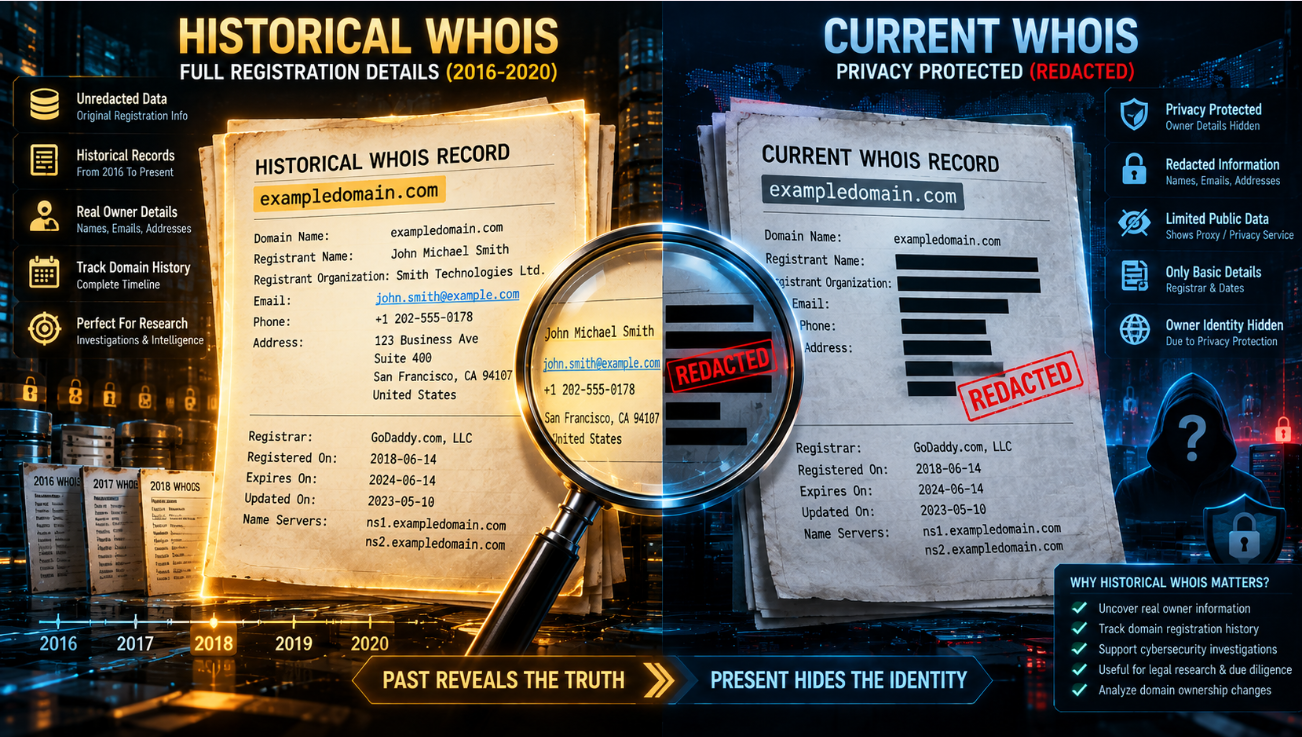
Every domain name has a story. It was registered by someone, at some point, for some purpose. The WHOIS system was designed to tell that story, to answer the fundamental question: who owns this domain? But the answer you get depends entirely on when you ask. Current WHOIS records show you the present owner. Historical WHOIS records reveal the past. Understanding the difference between these two data sources is critical for cybersecurity professionals, investigators, and anyone who needs to know the truth about a domain's ownership.
What Is Current WHOIS?
Current WHOIS is the live registration record for a domain name. When you perform a WHOIS lookup today, you receive the information that the registrar is currently publishing about the domain's owner. This includes the registrant's name, organization, email address, physical address, phone number, and technical details like nameservers and registration dates.
For decades, this information was publicly accessible to anyone. The internet operated with an open phonebook philosophy, transparency was the default, and domain owners accepted that their contact details would be visible to the world. That era ended in May 2018.
The GDPR Transformation
The implementation of the General Data Protection Regulation in the European Union fundamentally changed how WHOIS data is published. GDPR required that personal information be protected by default unless individuals explicitly consented to public disclosure. Since domain registration involves collecting personal data, and many registrants are European residents or businesses, GDPR forced a global shift in WHOIS practices.
ICANN, the organization that coordinates domain name systems, faced a direct conflict. Its contracts with registrars required publishing complete WHOIS information. European regulators made clear that continued public display of personal data would result in massive fines. Faced with this reality, registrars had no choice but to redact personal information from WHOIS output.
Today, when you look up a domain registered by an individual, you will likely see "REDACTED FOR PRIVACY" or "Data Protected" instead of actual contact details. The registrant's name, email, address, and phone number are hidden from public view. Organization names for businesses are sometimes still displayed, creating an inconsistent landscape where some records show company names while others appear completely blank.
What Is Historical WHOIS?
Historical WHOIS is the archived record of a domain's registration information over time. Before GDPR took effect, WHOIS records were fully public, displaying detailed contact information for every domain registrant. Commercial platforms continuously snapshot these records, preserving the data even after it disappears from current WHOIS output.
Historical WHOIS databases capture every change a domain undergoes: ownership transfers, registrar transitions, contact detail updates, and privacy lapses. If a domain was registered in 2015 and redacted in 2018, the historical records from those first three years contain a goldmine of unredacted information.
This permanence is what makes historical WHOIS so valuable. The GDPR regulations restricted future publication of personal data, but they did not erase records that were already public. Historical databases preserve what once was visible, creating a permanent forensic record that no amount of current obfuscation can hide.
The Critical Differences
The differences between historical and current WHOIS extend far beyond data availability. Understanding these distinctions is essential for anyone conducting domain investigations.
Data Availability and Redaction
Current WHOIS is heavily redacted for privacy. Personal information is hidden by default, with access restricted to law enforcement, intellectual property attorneys, and others with legitimate legal grounds. The public sees only anonymized contact information or web-based contact forms.
Historical WHOIS, particularly records from before May 2018, typically contains full unredacted contact information. Registrant names, email addresses, physical addresses, and phone numbers are preserved in their original form. This data was collected when transparency was the norm, and it remains accessible through historical databases.
Investigative Value
For threat intelligence and cyber investigations, current WHOIS has limited utility. When a malicious domain is registered with privacy protection, current records reveal almost nothing about the attacker. The registrant email is hidden, the name is redacted, and the only visible information is technical infrastructure data.
Historical WHOIS transforms investigations. Security researchers examining indicators of compromise routinely find that current records are redacted but historical records contain the email addresses and names that were once public. These historical details become pivot points for discovering connected infrastructure.
A practical example illustrates this power. Researchers investigating a domain tagged as an indicator of compromise found its current WHOIS record completely redacted. However, the historical record from 2011 showed an unredacted registrant organization, name, email address, and postal address. Using that historical email address for a reverse WHOIS lookup revealed thousands of other domains connected to the same actor.
Protocol and Access
Current WHOIS access has undergone a fundamental technical transformation. As of January 28, 2025, the Registration Data Access Protocol replaced traditional WHOIS as the definitive source for generic top-level domain registration information. RDAP offers structured JSON responses, secure HTTPS connections, and differentiated access based on user authorization. The old WHOIS protocol, with its inconsistent text formats and lack of standardization, has been sunsetted.
Historical WHOIS access operates through specialized platforms and APIs. Services like WHOIS History Search maintain databases of billions of records spanning decades. These platforms enable investigators to query domain histories, compare records over time, and identify unredacted data from pre-GDPR periods.
Why Historical WHOIS Matters for Cybersecurity
The value of historical WHOIS data for security professionals cannot be overstated. Every domain registration leaves a trail, and that trail persists even when current records are hidden.
Uncovering Hidden Connections
Threat actors frequently reuse email addresses, registrars, and naming patterns across their infrastructure. Historical WHOIS records capture these behavioral fingerprints. When an investigator finds an old, unredacted email address associated with a malicious domain, a reverse WHOIS query can reveal every other domain ever registered with that address.
This technique, called infrastructure pivoting, transforms a single indicator into a comprehensive map of an adversary's operations. What current WHOIS obscures, historical WHOIS reveals.
Attribution and Evidence
For legal proceedings, historical WHOIS records provide admissible evidence of domain ownership and registration activity. They establish timelines, document transfers, and create a verifiable chain of custody for digital evidence. Law enforcement agencies rely on this data to build cases against cybercriminals.
Identifying Domain Re-registration
Attackers sometimes acquire expired domains that were previously used for malicious purposes, or legitimate domains that have lapsed. A newly registered domain might be blocked by security systems trained to flag new registrations. A re-registered domain bypasses these defenses because its creation date appears old. Historical WHOIS data reveals these ownership changes, exposing the true nature of the domain.
The Practical Workflow
For security professionals conducting investigations, the workflow typically follows this pattern. Start with a suspicious domain and query its current WHOIS record to gather basic registration details. If the record is redacted, move to historical WHOIS to find unredacted data from pre-2018 records. Extract any email addresses or names found. Use reverse WHOIS lookups on those identifiers to discover connected domains. Pivot through DNS history and passive DNS data to map the full infrastructure.
Each step enriches the investigation, building confidence about connections between domains and the actors behind them.
Making the Right Choice
The choice between historical and current WHOIS is not either-or. Both have roles in a comprehensive investigation. Current WHOIS provides the authoritative, real-time record and is the proper source for technical data like nameservers and registration status. Historical WHOIS provides the forensic depth needed for attribution and infrastructure mapping.
For threat intelligence, historical WHOIS is indispensable. For domain management and verification, current records suffice. Understanding when to use each source is a fundamental skill for anyone working in cybersecurity.
Conclusion
The difference between historical and current WHOIS is the difference between seeing a locked door and finding the key. Current WHOIS shows you what exists today, often behind a wall of privacy redaction. Historical WHOIS reveals what existed before, preserving the unredacted details that threat actors wish would disappear.
For cybersecurity professionals, the ability to access and analyze historical WHOIS data is not a luxury, it is a necessity. Every domain has a history, and that history contains the truth. The challenge is knowing where to look and how to read the records that time has preserved.